

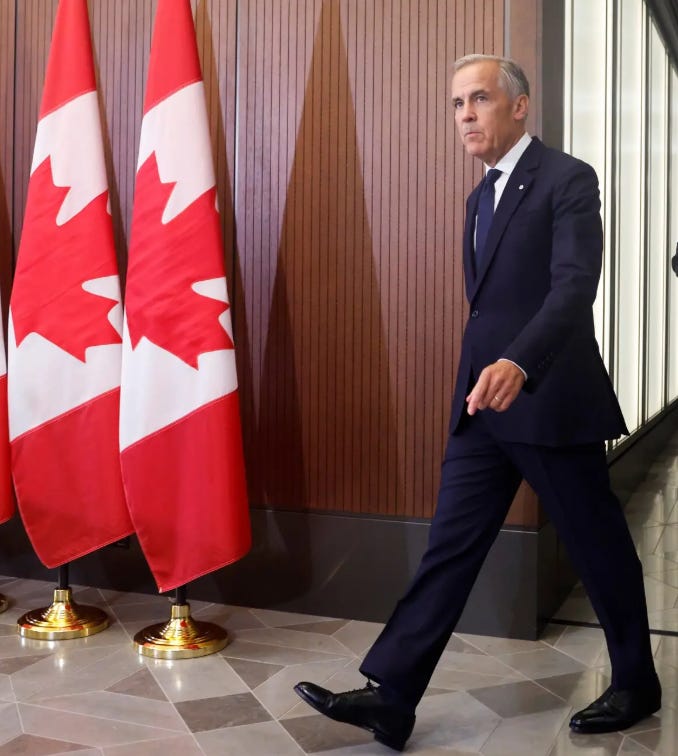
“Last spring, I warned that America is trying to break us so that they can own us. And I promised: ‘That will never, ever happen.’ We are keeping that promise,” Canadian Prime Minister Mark Carney, August 22, 2026
On Saturday, a reporter asked why it feels like Canada is going to war with the United States. “You’re at war when you get attacked.” Carney said. “We got attacked.”
If you did not have a bitter mutually destructive war with our friend and ally to the North on your bingo card, you are not alone.
“The strong can do what they can, and the weak must suffer what they must.”
If you’ve been paying attention, Carney’s willingness to stand up to Trump should not come as a complete surprise. The Canadian leader has been signaling his defiance for months. Back in January, he drew a standing ovation in Davos when he delivered a speech warning of a “rupture” with the United States.
“Every day we’re reminded that we live in an era of great-power rivalry,” Mr. Carney said. “That the rules-based order is fading. That the strong can do what they can, and the weak must suffer what they must.”
And he warned, “The middle powers must act together because if we’re not at the table, we’re on the menu.” (You can read the text of his speech here.)
But what happened this weekend was still shocking, because it was so rare. “On Friday night,” reports the NYT, the Canadian PM “did something that few other world leaders before him have dared to do.”
After days of intense trade negotiations with the United States, with less than an hour to go on a midnight deadline for a new round of tariffs from the Trump administration, Mr. Carney instructed his negotiators to walk away.
Then, he announced that once 50 percent tariffs came into effect on $20 billion worth of Canadian goods, he would order retaliatory tariffs on the United States “dollar for dollar.”
Then on Saturday, in a lengthy televised address to Canadians, Mr. Carney brought fighting words to Canada’s act of defiance.
“Last spring, I warned that America is trying to break us so that they can own us. And I promised: ‘That will never, ever happen.’ We are keeping that promise,” Mr. Carney said somberly, before reporters in Ottawa.
“Canada is becoming stronger and less dependent on America. We are already giving ourselves more than they can take away. And we are just getting started,” he added.
By walking away, Mr. Carney chose a road that no major U.S. ally has taken: With his country’s economy on the line, he stood up to President Trump and refused to accept the administration’s offer of a new trade relationship with tariffs permanently baked in. Britain, the European Union and other major U.S. trading partners have agreed to smaller deals that have been volatile and often left them worse off.
In announcing the collapse of talks — days after Trump had falsely claimed that the deal was done — Carney said that the U.S. “asked too much and offered too little,” and questioned the reliability of any agreement with Trump, gibing that agreements with the United States turned out “to be written in pencil.” Some of the US demands were simply bizarre. Via the CBC:
The prime minister revealed that the U.S. had issues with Canada’s subsidies for French culture; the prevalence of French-language media online and even the requirement to have bilingual labels on products sold in Canada.
“It was unacceptable right from the start, but the Americans kept trying and trying and we said no,” Carney said. “Ultimately, it’s simple. That was never on the table for Canada and it would not have been acceptable to Canadians.”
But that was not the dagger that killed the deal.
For years now the Smart Kids have been telling us that we should take Trump seriously, but not literally, while others laughed off his repeated reference to Canada as our 51st state merely as Trumpian trolling. But just as his threats to invade Greenland ended up wrecking the NATO alliance, it was Trump’s contempt for Canadian sovereignty that triggered this new multi-billion-dollar trade war — and shattered centuries of trust and comity.
It’s the sovereignty, stupid.
In the end, this was why the talks imploded: Trump demanded control over the trade deals Canada was making around the world. "The U.S. introduced in the last hours, efforts to restrict our ability to have other trade deals,” Carney said on Saturday. “We're the partner of choice in many respects for countries around the world, and the Americans wanted to restrict that. Unacceptable."1
So, this was not merely about tariffs. “Trump tried to turn Canada into a Vassal State with less than an hour on the clock,” writes Dean Blundell. Trump demanded exclusive access to Canada’s rare earth minerals and control over Canada’s ability to sign trade deals with other countries.
A reporter asked Carney why the Americans would want control over Canadian foreign trade policy.
“It’s a power play.”
Carney, however, refused to bend the knee.
**
Canada’s defiance comes at an awkward moment for Trump, who is losing both his war in Iran and his war on American consumers. Notes the Wapo: Canad’s stance comes as “Trump was retreating on another trade front.”
On Friday, after insisting for more than a year that tariffs do not affect consumer prices, he lifted tariffs on beef imports, saying the move would lead to lower grocery prices.
The two developments, coupled with legal challenges to Trump’s tariffs, leave the president’s signature economic policy in a state of flux.
And the world is watching.
“It’s a big setback for Trump’s trade policy. We’re at a juncture where other countries may be very closely watching how this plays out as they also are becoming increasingly frustrated with the demands the U.S. is placing on them in these largely one-sided trade agreements,” said Wendy Cutler, a former U.S. trade negotiator who is now senior vice president at the Asia Society Policy Institute.
**
Finally, David Frum predicts that Trump will lose this war with Canada the same way he lost the Iran War.
Yes, Trump can hurt Canada more than Canada can hurt Trump. That part of Trump’s thinking is true. But wars are not decided only by the question Who can inflict more pain? Wars are also decided by the question Who can endure more pain? Trump’s failure to accept this truth is why he lost the Iran war—and why he is losing his trade wars.
Canadian Prime Minister Mark Carney has much more political permission to accept pain from a U.S.-Canadian trade war than Trump does.
**
BONUS. This seems like a BFD: Retired General Barry McCaffrey is saying that the US has now “permanently lost access to 15 Persian Gulf bases. Iran [is] now poised to control access [to] the Gulf States. US will have to negotiate new access in western Saudi Arabia, Israel, southern Europe.”

If this is true, notes veteran journalist Paul Farhi: this would be “an absolute calamity. Billions of dollars invested, decades of diplomacy to establish and maintain those bases. And all wiped out in a few months?”
A week of commentary
From Natalie Harp to trade wars, it was a busy week.
Monday

Tuesday


Wednesday

Thursday


Friday

Saturday

NOTE: If this work has value to you, please consider becoming a paid subscriber. The dogs and I are extremely grateful!
Sunday dog
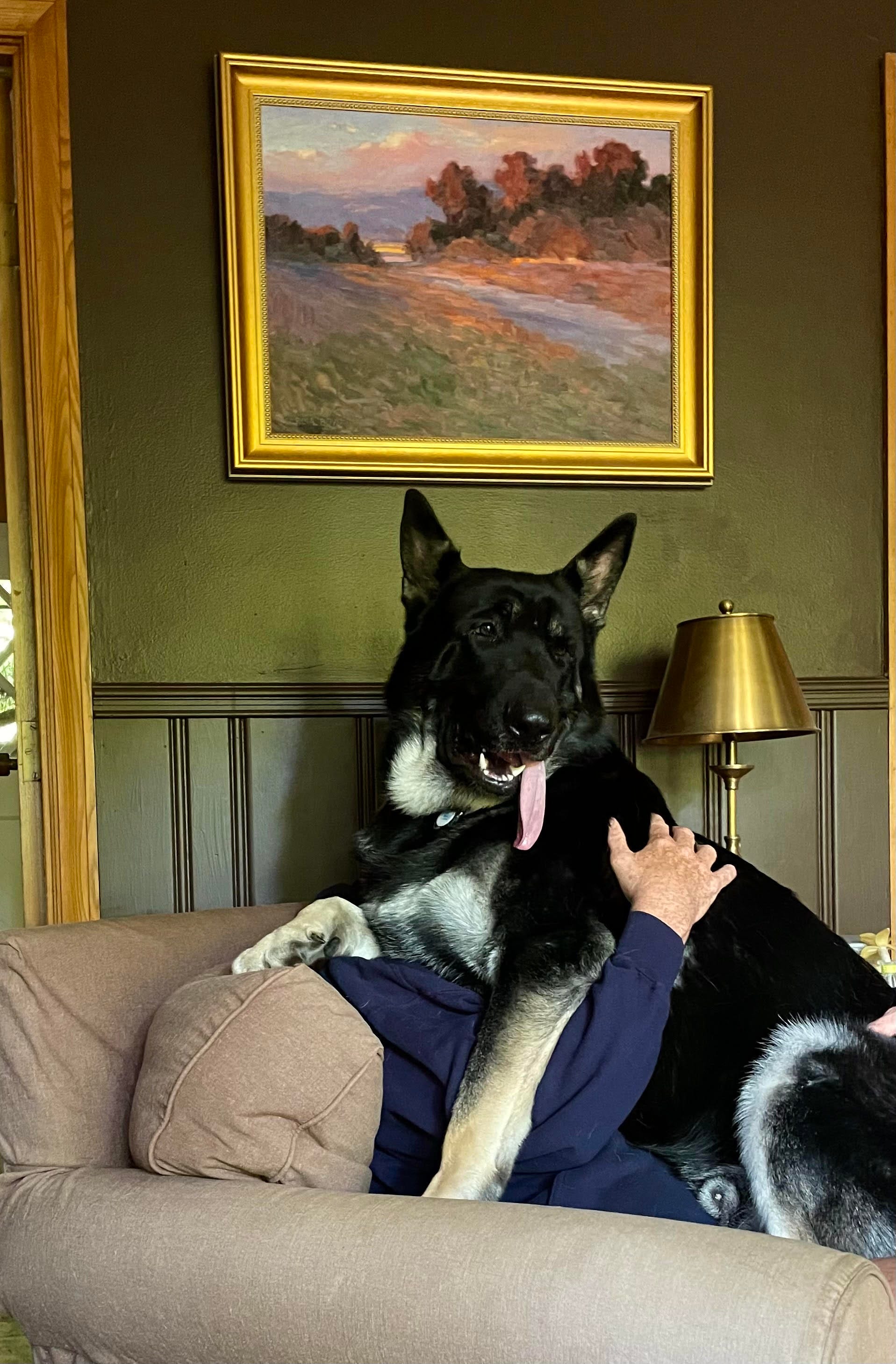
Eli has always thought of himself as a lap dog. Seriously.
This is what Carney said in Davos about the attack of the sovereignty of nations like Canada:
More recently, great powers began using economic integration as weapons. Tariffs as leverage. Financial infrastructure as coercion. Supply chains as vulnerabilities to be exploited. You cannot “live within the lie” of mutual benefit through integration when integration becomes the source of your subordination. The multilateral institutions on which middle powers relied— the WTO, the UN, the COP—the architecture of collective problem solving — are greatly diminished.
As a result, many countries are drawing the same conclusions. They must develop greater strategic autonomy: in energy, food, critical minerals, in finance, and supply chains. This impulse is understandable. A country that cannot feed itself, fuel itself, or defend itself has few options. When the rules no longer protect you, you must protect yourself. But let us be clear-eyed about where this leads. A world of fortresses will be poorer, more fragile, and less sustainable.
And there is another truth: if great powers abandon even the pretence of rules and values for the unhindered pursuit of their power and interests, the gains from ‘transactionalism’ become harder to replicate. Hegemons cannot continually monetize their relationships. Allies will diversify to hedge against uncertainty. Buy insurance. Increase options. This rebuilds sovereignty— sovereignty which was once grounded in rules—but which will be increasingly anchored in the ability to withstand pressure.
I think Carney and our erstwhile allies have figured out it doesn't pay to placate Trump, and it also doesn't pay to negotiate with Trump because he's likely to renege on any agreement the United States has made in the past. When you look at the United States supporting groups like AfD in Germany, the National Front in France, Nigel Farage's Reform party, and separatist groups in Alberta, Carney likely took all of that into consideration decided enough was enough. And good for him.
Of course, the damage is done, and Canada won't trust us again for a very, very long time. And by us, I mean the voters because we're the ones who set this shitshow in motion.
Canadians knew it would be Canada. We started the economic boycott on our own. That gives our government a lot of room.